Chromatin Profiling Analysis @ CRS
Workflow
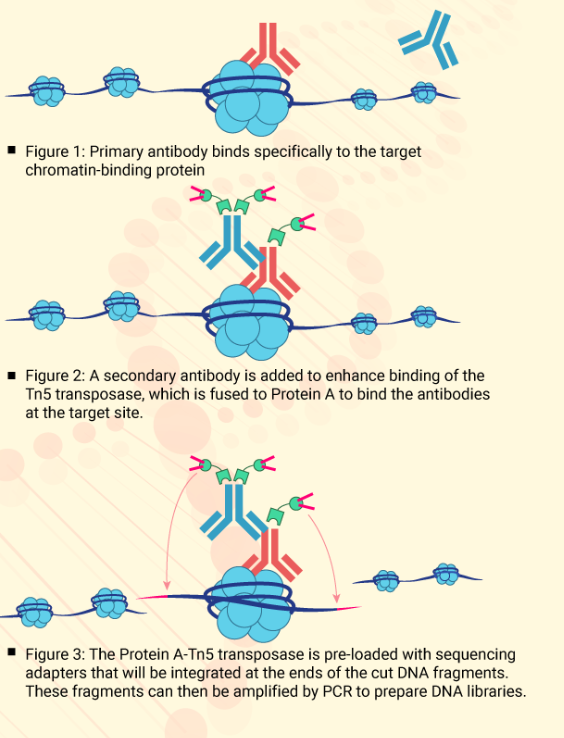
Image from http://www.abclonal.com/
- Profiling histone post-translational modifications
- Mapping transcription factor binding sites
- Studying chromatin accessibility at specific regulatory regions
- Epigenetic landscape characterization in low-input or single-cell samples
- Investigating dynamic chromatin changes during development or disease
Workflow
Assay of Transposase Accessible Chromatin (ATAC-Seq) Measures genome-wide chromatin accessibility, providing insights into regulatory regions such as promoters and enhancers. A hyperactive transposase inserts sequencing adapters into open chromatin regions, allowing direct sequencing of accessible DNA. This technique requires minimal input material and enables rapid profiling of chromatin states, making it a powerful tool for studying transcriptional regulation and epigenetic dynamics. This workflow is from experiences in the Jessica Lang Lab at CPM, based on a modified protocol from Corces et al. Nature Methods 2017 (https://www.nature.com/articles/nmeth.4396). Potential Applications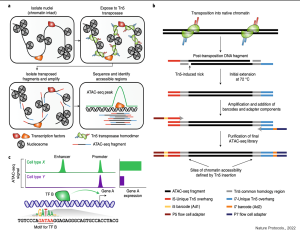
- Mapping open chromatin regions genome-wide
- Identifying active promoters, enhancers, and regulatory elements
- Studying transcriptional regulation in different cell types or conditions
- Profiling chromatin accessibility in rare or low-input samples
- Integrating with other epigenomic assays to link accessibility with histone modifications or transcription factor binding
Schematic of the ATAC-seq transposition reaction and library preparation. Corces, et al. Nature Protocols 2022 https://www.nature.com/articles/s41596-022-00692-9
Epigenomics Contacts
Loading…
Price
| CUT&Tag | Member | Non-member |
| Library prep, QC/Sample | $63 | $63 |
| P1 100c flow cell | $711 | $1,316 |
| Service Charge | $130 |
The price may change for sample sizes greater than 32, the scope of work, and the flow cell used.
| ATAC-seq: basic chromatin analysis | Member | Non-member |
| Library prep, QC/Sample | $113 | $113 |
| P2 100c flow cell | $1,072 | $1,677 |
| Service Charge | $130 |
The price may change for sample sizes greater than 32, the scope of work, and the flow cell used.
| ATAC-seq: transcription factor foot printing | Member | Non-member |
| Library prep, QC/Sample | $113 | $113 |
| P4 100c flow cell | $2,649 | $3,254 |
| Service Charge | $130 |
The price may change for sample sizes greater than 32, the scope of work, and the flow cell used.